Most people work this out in the wrong order. They agree an arrangement with a neighbour or a relative, settle on a weekly figure, and only later find out that the arrangement they described in one sentence has three different official meanings attached to it, and that two of them come with paperwork.
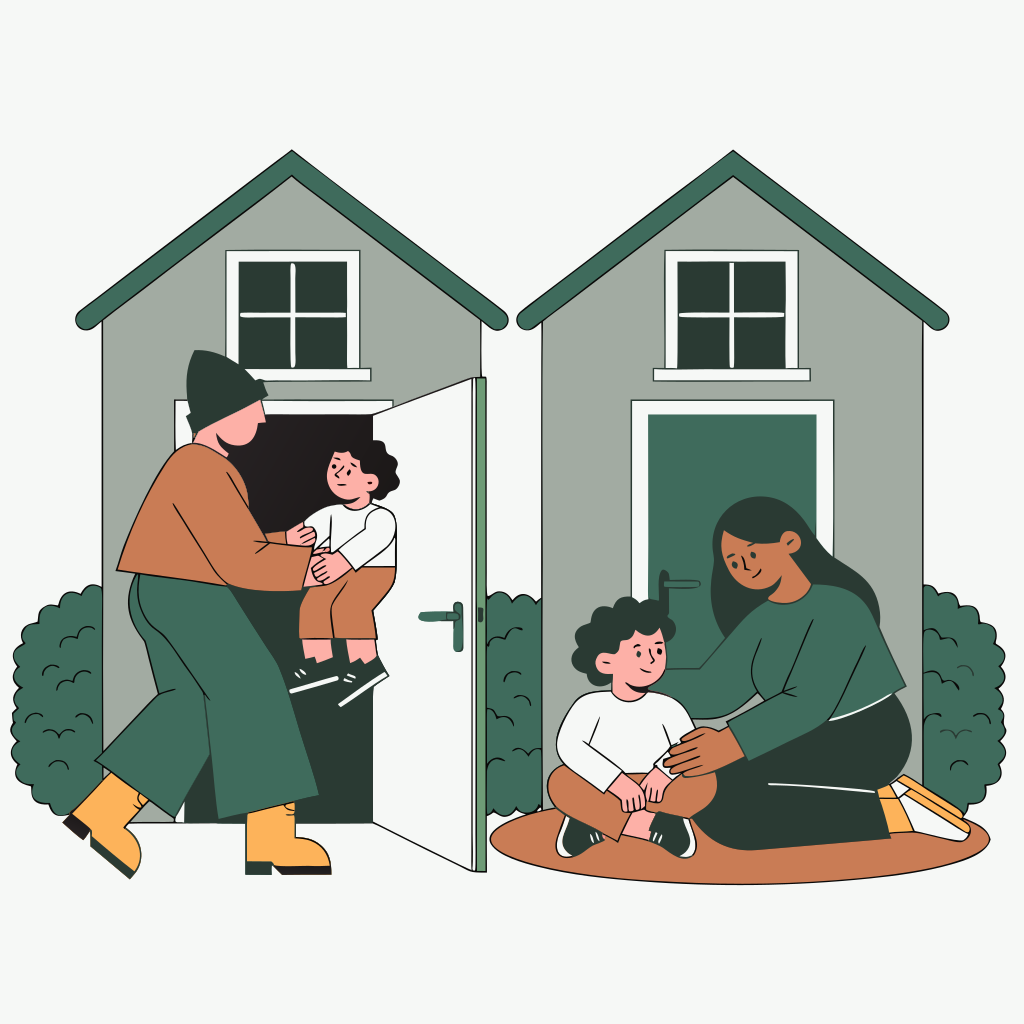
The good news is that one question sorts almost all of it, and you can answer it before anything else: whose home is the child in?
The short version
- The line that decides everything
- A childminder minds children in the minder's own home. In your home it is a nanny or au pair, and that is a different thing in law
- In their home
- They may be able to claim tax relief on childminding income up to €15,000, and apply for a grant of up to €1,000. Both are theirs, not yours
- In your home
- You are very likely their employer. At €40 a week or more you must register as an employer with Revenue
- Minimum wage
- €14.15 an hour since 1 January 2026, unless they are a close relative of yours
- National Childcare Scheme
- Only if the provider is registered with Tusla and holds an NCS contract. A nanny in your home never qualifies
- Who decides
- Revenue for tax, Tusla for registration, the Workplace Relations Commission for employment rights
The word childminder has a legal meaning, and it is about the address
Citizens Information defines it plainly: a childminder is a person who cares for other people's children, under the age of 15, in the minder's own home, for at least 2 hours a day. And then it says the part that catches people out: that definition does not apply to people who care for children in the family's home, such as nannies and au pairs.
So two arrangements that feel identical to you, the same person minding the same child for the same hours at the same price, sit in two different places in the system depending on which front door the child goes through in the morning.
If they mind in their own home
This is childminding proper, and it is the lighter of the two arrangements for you. Citizens Information states that parents and childminders arrange their own terms and conditions: there is no standard contract handed down by anyone.
There are limits on numbers, and they include the minder's own family:
- Up to 6 children at one time.
- No more than 2 of them under 15 months, unless those two are siblings of each other.
- That count includes the childminder's own children if they are under 10 and in the childminder's care while the service is operating. If their own children are at home but being minded by somebody else, they are not counted.
Two supports exist on this side, and both are worth knowing about even though neither is yours. The Childminding Development Grant is up to €1,000 from the local City or County Childcare Committee, for toys, educational items, childcare equipment, safety equipment and IT equipment. And there is a tax relief, which is the one that gets misread most often.
The €15,000 exemption is the minder's, not a discount on your bill. Revenue's Childcare Services Relief exempts childminding income up to €15,000 a year. To qualify the minder must provide the service in their own home, mind no more than three children under 18 at any one time, be self employed and registered for self assessment, and show they have notified the authorities that they provide childcare services. If two people provide the service together in the same home, the €15,000 is divided between them. There is no relief for a parent on what they pay for childcare.
One wrinkle worth flagging because you may meet it: Revenue's page on the relief still says the minder must show they have notified the Health Service Executive. Citizens Information, on the other hand, describes Tusla, the Child and Family Agency as the body that regulates and inspects childcare services. Two official pages, two different bodies, and we have written what each one actually says rather than quietly modernising Revenue for them. If it matters to your arrangement, ask Revenue or your local City or County Childcare Committee where the notification goes today.
If they mind in your home, you are almost certainly an employer
Someone employed to work in a private home is a domestic worker, and Citizens Information lists childminding among the duties that make someone one. Au pairs are named explicitly as an example of a domestic worker who lives with their employer.
The threshold is much lower than most people expect:
€40 a week is the line, and there is a second condition people miss. Revenue puts the exemption this way: you do not need to register as an employer if you have a domestic employee, you pay them less than €40 per week, and you have only one such employee. Both halves have to be true. Two part-time minders, each paid under the threshold, and you are registering anyway. At or above €40, or with a second employee, you register with Revenue and operate PAYE in the normal way. Under the Domestic Employer Scheme, which has run since 1997, the PRSI for the exempt case is paid to the Department of Social Protection in a single payment at the end of the tax year instead. Almost every real arrangement is above €40 anyway.
Once you are an employer, the obligations are the ordinary ones, and they are not optional:
- A written contract of employment stating the full names of both of you, the job title or nature of the work, the pay and the hours. You cannot change those conditions without their agreement.
- At least the national minimum wage, €14.15 an hour since 1 January 2026.
- A payslip, showing the PAYE, PRSI and USC deducted.
- Deducting PAYE, PRSI and USC from their wages, and paying the employer's PRSI contribution yourself on top.
- A Sunday premium for any hours worked on a Sunday, if it is not already built into the rate: an allowance, a higher rate for those hours, or paid time off.
- Records kept for 3 years, which a Workplace Relations Commission inspector can ask to see.
And the working conditions are the ordinary ones too: a maximum of 48 hours a week averaged over 4 months, which does not cap any single week at 48, 11 consecutive hours' rest in any 24, a full 24 consecutive hours' rest each week, a 15 minute break after four and a half hours and a 30 minute break after six. They have a statutory right to 5 days' sick pay, at least 4 weeks' paid annual leave, and the 10 public holidays paid, or another paid day off, or an extra day's pay. If they travel with you on holiday, that is work and it is paid.
When it ends they are entitled to notice, and once they have been with you over a year they are protected against unfair dismissal.
Calling it an au pair arrangement does not change any of this. The Workplace Relations Commission states that designations such as au pair, and other descriptions of arrangements between consenting parties, do not in themselves mean that a person working in a home is not an employee under Irish law. The word on the advert does not decide the status; what actually happens does.
One more thing to check before you offer the job. In general, non-EEA citizens cannot get employment permits for any work in private homes, because that work is on the ineligible list of occupations. That is a question to settle first rather than after an arrangement has started.
The subsidy question, which is where the real money is
This is the part most likely to cost you, and it is decided by a condition that has nothing to do with how good the arrangement is. To attract a National Childcare Scheme subsidy, your childcare provider must be registered with Tusla and must hold an NCS contract with the Department of Children, Disability and Equality. You apply, but the money is paid to the provider and comes off your bill.
Two consequences follow, and they are worth pricing before you agree anything:
- A nanny or au pair in your home can never attract the subsidy, because they are not a registered provider. There is no route to it.
- A childminder in their own home can, but only if they are registered with Tusla and hold an NCS contract. Not every childminder is. Ask before you agree the arrangement, not after.
Our guide to the National Childcare Scheme covers the two subsidies, the income thresholds and how to apply.
What this page will not tell you, and why
It will not tell you what to pay. There is no official going rate for childminding in Ireland, no public body publishes one, and any figure circulating in a forum is somebody's arrangement rather than a rule. We do not publish figures that are not on an official page, so we are not going to invent one here.
What you can anchor on is the floor rather than the market. If the person is your employee, the minimum wage of €14.15 an hour is a legal minimum, not a suggestion, and the employer's PRSI contribution sits on top of whatever you agree. You cannot agree a lower rate, and an employee cannot waive it. The one exception is a person employed by a close relative, for example a spouse, civil partner or parent, who is outside the minimum wage entirely. That exception is the reason a grandparent minding the children is a genuinely different case from a neighbour doing it.
Who decides what
Three different bodies, and sending a question to the wrong one costs weeks. Revenue decides tax, the Childcare Services Relief and employer registration. Tusla regulates and inspects childcare services and holds the register that the subsidy depends on. The Workplace Relations Commission handles employment rights, and it is where a complaint about a contract, wages or dismissal goes. The Department of Children, Disability and Equality runs the National Childcare Scheme, and your local City or County Childcare Committee is the practical first phone call for anything local, including the development grant.
See your childcare steps and deadlines in one place
parentready turns the official rules into a personalised, ordered checklist for your situation. Free, private, and on your device.
Official sources
- Citizens Information: Your childcare options (the definition of a childminder, the numbers limit, the development grant, and the National Childcare Scheme conditions)
- Citizens Information: Domestic workers' employment rights (the €40 a week registration threshold, the contract, hours, leave and the employer's tax obligations)
- Citizens Information: Minimum wage (the €14.15 rate and the close-relative exception)
- Revenue: Childcare services (the €15,000 Childcare Services Relief and its conditions)
- Workplace Relations Commission: Domestic workers (that a designation such as au pair does not decide employee status, and the Sunday premium)
- Revenue: Registration of employers for PAYE purposes (the under €40 exemption and the one-employee condition)
- gov.ie: Operational Guidelines: PRSI Special Collection System (the Domestic Employer Scheme)
Facts checked against the official pages on 18 September 2026. This is general information, not legal, tax or financial advice, and it does not decide anyone's employment status, tax position or subsidy entitlement. Employment status in a particular case is a question of fact that Revenue, the Workplace Relations Commission or the Department of Social Protection decide, not us. Rates and rules are set by government and can change; always confirm on the official pages linked above.